

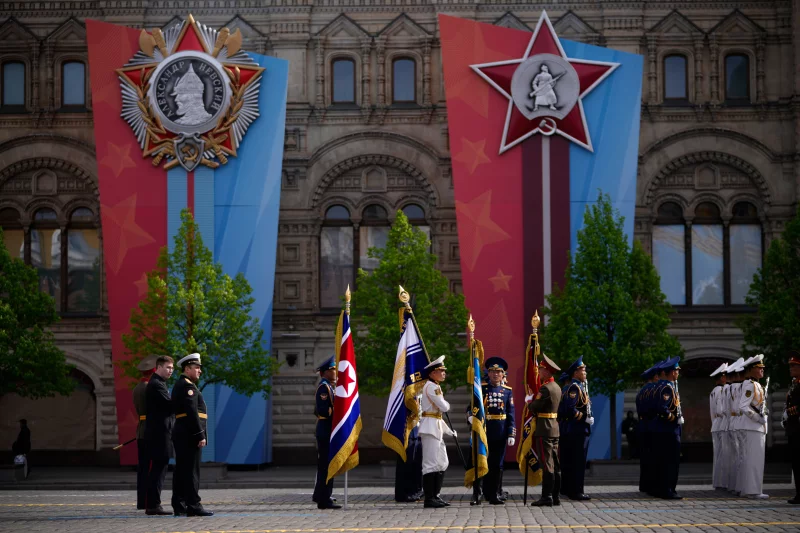
MOSCOW — Russian President Vladimir Putin on Saturday voiced confidence of victory in Ukraine as he oversaw a military parade on Red Square commemorating the defeat of Nazi Germany in World War II.
Security was tight in Moscow as Putin and several foreign leaders attended the parade, even as a U.S.-brokered three-day ceasefire eased concerns about possible Ukrainian attempts to disrupt the festivities.
Putin, in power for more than a quarter-century, has used Victory Day, Russia’s most important secular holiday, to showcase the country’s military might and rally support for his military action in Ukraine, now in its fifth year.
Speaking at the parade, Putin hailed Russian troops fighting in Ukraine, declaring that they “face an aggressive force that is armed and supported by the entire bloc of NATO.”
“Victory has always been and will be ours,” Putin said as columns of troops lined up on Red Square. “The key to success is our moral strength, courage and valor, our unity and ability to endure anything and overcome any challenge.”
But this year, for the first time in nearly two decades, the parade took place without tanks, missiles and other heavy weapons, aside from a traditional flyover of combat jets.
Officials explained the sudden change of format by the “current operational situation” and said that additional security measures have been taken in response to the threat of Ukrainian attacks.
For the first time, Saturday’s parade featured troops from North Korea, a tribute to Pyongyang that sent its soldiers to fight alongside Moscow forces to repel a Ukrainian incursion into Russia’s Kursk region.
Earlier ceasefires failed to hold
Russia declared a unilateral ceasefire for Friday and Saturday, while Ukrainian President Volodymyr Zelenskyy announced a truce that was supposed to begin on May 6, but neither of them held as the parties traded blame for continuing attacks.
U.S. President Donald Trump announced Friday that Russia and Ukraine have bowed to his request for a ceasefire running Saturday through Monday and an exchange of prisoners, declaring that the break in fighting could be the “beginning of the end” of the war.

Leave a Reply